REA (Reverse Engineer Anything)
Reverse engineer anything with agents, from app behavior down to native binaries.
Real cases of what people did with REA (Reverse Engineer Anything), the open-source MCP server for reverse engineering, each with its original source.
Launched: · Last updated:
Reverse engineer anything with agents, from app behavior down to native binaries.
REA, the Viral Reverse Engineering Tool: Should Lazy People Install It? In the past two weeks, the hottest project on GitHub is probably REA (Reverse Engineer Anything). 1
YouTube explainer on the REA (Reverse Engineer Anything) MCP tool, linking the morluto/rea repository and showing how users of AI coding IDEs such as Claude Code, Cursor, Windsurf, Replit and Codex can apply it to reproduce software via a clean-room design approach.
วิดีโอภาษาไทยที่พาไปเจาะเบื้องหลังโปรเจกต์ Reverse Engineer Anything (REA) บน GitHub ผ่านการอ่าน Source Code และกรณีศึกษาสาธารณะ ตั้งแต่การวิเคราะห์แอป Android, Notion, เกมเก่า DX-Ball ไปจนถึงโปรเจกต์ต่อยอดอย่าง Ledger Reborn และ ReaCut พร้อมพูดถึงข้อจำกัดของ REA
El autor prueba REA (Reverse Engineer Anything), el MCP de ingeniería inversa, usando su propia aplicación de código abierto Elite Pen como caso de estudio, restringiendo el acceso al código fuente para analizar el binario compilado y obtener pseudocódigo.
A Reddit post presenting coop-anything, a GitHub project in the style of REA that adds cooperative multiplayer to existing single-player games. The author reports completed online co-op for Deus Ex, Dungeon Keeper and Stalker SOC, with Ocarina of Time and Fallout New Vegas in progress, using engine knowledge plus tools like REA and Ghidra.
A post describing REA (Reverse Engineer Anything), a tool that connects to coding agents and uses real reverse-engineering tools like Ghidra, labeling findings as seen, guessed, or unknown.
A YouTube walkthrough of REA (Reverse Engineer Anything), covering what it is, how to install it in Claude Code or Codex, a live attempt to understand and rebuild Stripe's animated wave, five user builds, and caveats about legality, accuracy and cost.
One sponsored card rotates in after every 6 projects
Advertise hereAICodeKing benchmarks LeanREA, an 8 KB skill file, against REA (Reverse Engineer Anything), explaining REA's internals and comparing speed, cost and accuracy across 36 runs.
One sponsored card rotates in after every 6 projects
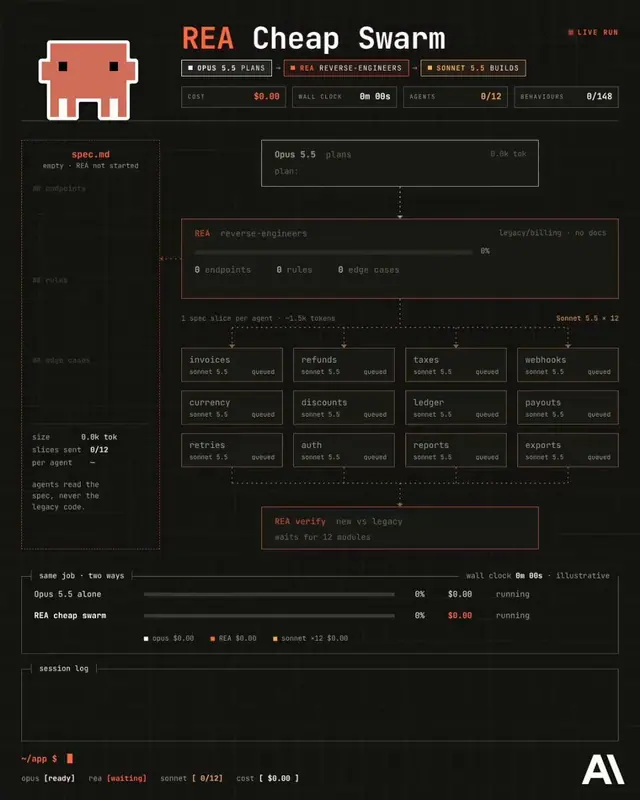
Advertise hereAn X post describing a workflow where REA (morluto/rea) reverse-engineers a legacy billing system into a spec.md (14 endpoints, 37 rules, 9 edge cases), with twelve Sonnet agents building modules from spec slices and REA VERIFY replaying the new system against the legacy one (148/148 behaviours match). The post links to the MIT-licensed GitHub project and gives the npx rea-agents setup install command, plus a warning about sending tool results to model providers.
 ▶ ♫
A step-by-step YouTube tutorial on installing the REA (Reverse Engineer Anything) GitHub skill into Claude Code and using it to analyse an app, with a demo that analyses the open-source Excalidraw website and rebuilds a simplified version.
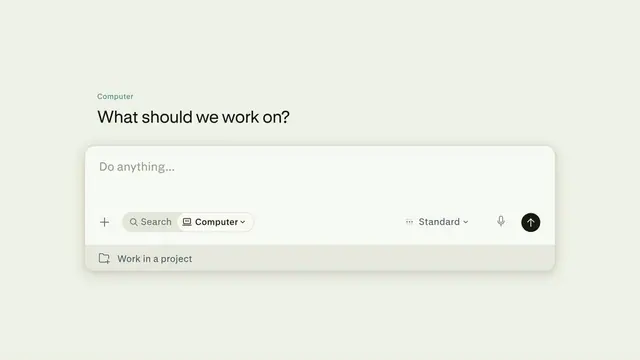
Perplexity integrates the open-source reverse engineering tool REA (Reverse Engineer Anything) into Computer. Users only need to describe the software they want to replicate, and the AI can analyze how it works without the original source code, then attempt to rewrite a version with similar functionality. The 5 showcased replicated works include Figma, LibreOffice Calc, Photopea, Harvey, and Audacity, all providing online experience versions. REA is open-sourced by developer morluto and can be used with Ghidra and Hopper to analyze internal functions and call relationships of programs. It can also inspect web pages, JavaScript, and Electron applications; the author emphasizes that it cannot guarantee restoration of the original source code. Before October 31, using the /reverse-engineer task can get each person up to 10,000 Credits free quota.
 ▶ ♫
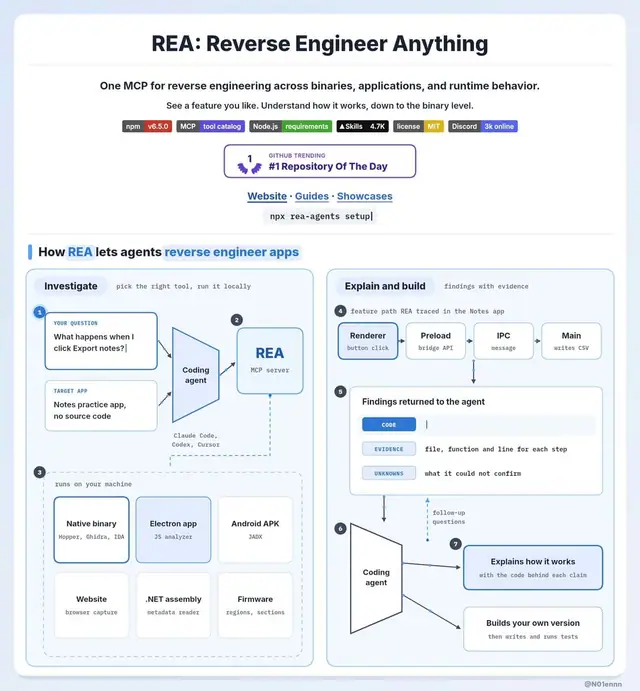
this is f*cking dangerous REA lets your agent read any closed-source app on your laptop, down to the binary here's what happens when you ask it one question: > you ask: what happens when I click Export? > your agent calls REA, one MCP server, running on your machine > REA picks the engine: Ghidra, IDA, JADX, a browser, or none at all > it traces the click: renderer -> preload -> IPC -> main > findings come back with the code, the evidence and the unknowns > your agent explains how the feature works > then builds your own version and tests it MIT. runs locally. #1 repo of the day on GitHub. npx rea-agents setup
 ▶ ♫