Heroic steps @heroicsteps_real
Tutorial resources · by Heroic steps
REA: "Reverse Engineer Anything", Tested on a Real Binary
A hands-on review and demo of REA (rea-agents 6.4.0), showing installation, Ghidra setup on Apple Silicon, decompilation of a self-written stripped binary, and mapping an Electron app's IPC export flow.
About this case
REA (Reverse Engineer Anything) is a free, open-source (MIT) toolbox that lets AI agents like Claude Code, Codex and Cursor look inside software without its source code: websites, JavaScript/Electron apps, .NET, Android, firmware and native binaries. 195,665 GitHub stars; npm package rea-agents 6.4.0.
Setup
See the original source for installation instructions.
Original text / README
REA: "Reverse Engineer Anything", Tested on a Real Binary
REA (Reverse Engineer Anything) is a free, open-source (MIT) toolbox that lets AI agents like Claude Code, Codex and Cursor look inside software without its source code: websites, JavaScript/Electron apps, .NET, Android, firmware and native binaries. 195,665 GitHub stars; npm package rea-agents 6.4.0.
Install:
- Node.js 22+ and npm
npx rea-agents setup(registers REA with your AI agent; review the changes it proposes)- For native code: install a decompiler, e.g. the free Ghidra 12.1 + JDK 21, then
export GHIDRA_INSTALL_DIR=…and runrea doctorApple Silicon note: Ghidra's release has no Apple Silicon decompiler. I built it from Ghidra's bundled source in 28 s (make ghidra_opt ARCH_TYPE="-arch arm64", plussleigh_opt, copied into Ghidra/Features/Decompiler/os/mac_arm_64/).
My test on an Apple M4 Mac (only on software I wrote): Test 1, a stripped binary
- I wrote a small game that turns a player and level into a seed, compiled it with clang -O2, stripped all symbols and hid the source
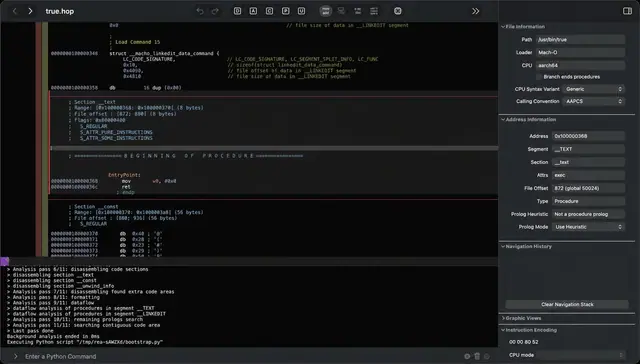
- REA traced the printed text to main, found the unnamed function it calls and decompiled it (each step about 9 s)
- the pseudocode exposed the lookup table the compiler had hidden in the math: 3, 1, 4, 1, 5, 9, 2, 6 (the digits of pi), exactly what I wrote
- I rebuilt the function only from REA's output; it matched the real binary on 2,000 / 2,000 random inputs Test 2, an Electron app
- a small notes app I wrote, packed into app.asar
- in about 6 s REA mapped the export feature: saved notes → bridged API → IPC "notes:export" → main-process handler, each with file and line
- it flagged that the IPC handler never validates the sender For agents: REA's MCP server offers 170 tools and 6 guided prompts.
The fine print: use it only on software you own or are authorized to examine; commercial tools (IDA, Hopper, JEB) need proper licences; my test function was tiny, and real apps are far larger, so you (or your agent) still have to reason about the evidence.
Chapters 0:00 The claim 0:24 What it is 0:46 Install 1:13 Test 1: a binary 2:08 Test 2: an app 2:35 For agents 2:47 Fine print 3:03 Verdict
Sources (checked 13 Oct 2026)
- https://github.com/morluto/rea (stars, forks, commits via the GitHub API), README, docs/installation.md, docs/cli.md, DISCLAIMER.md
- My own hands-on test (rea-agents 6.4.0, Ghidra 12.1.4, JDK 21, Apple M4), on a binary and an app I wrote myself
#REA #ReverseEngineering #Ghidra #AIAgents #ClaudeCode #CyberSecurity #OpenSource
Similar projects

morluto@morluto
Reverse engineer anything with agents, from app behavior down to native binaries.
REA (Reverse Engineer Anything)
Stars 214.4K

cyberkaida@cyberkaida
MCP server for reverse engineering tasks in Ghidra 👩💻
rea / reverse-engineering-assis
❯ /reverse-engineering-assistant▰▰▰▰▰▰▰▰ Tools & integrations
✳︎ reverse-engineering-assistant
└─ Make every conversation easier
Text preview · Not a project screenshot✳︎ reverse-engineering-assistant
└─ Make every conversation easier
reverse-engineering-assistant
Stars 872

ringozzt@ringozzt
A Chinese-language technical survey of how REA lets a coding agent analyse software without its source code.

REA in depth: an MCP toolchain for source-free analysis
Stars 39