REA (Reverse Engineer Anything)
Reverse engineer anything with agents, from app behavior down to native binaries.
Real cases of what people did with REA (Reverse Engineer Anything), the open-source MCP server for reverse engineering, each with its original source.
Launched: · Last updated:
Reverse engineer anything with agents, from app behavior down to native binaries.
A YouTube explainer that walks through the open-source "Reverse Engineer Anything" (REA) tool: how software is compiled versus decompiled, why AI agents are effective at reverse engineering, what REA does, what people have built with it, and the limits and risks of reading machine code.
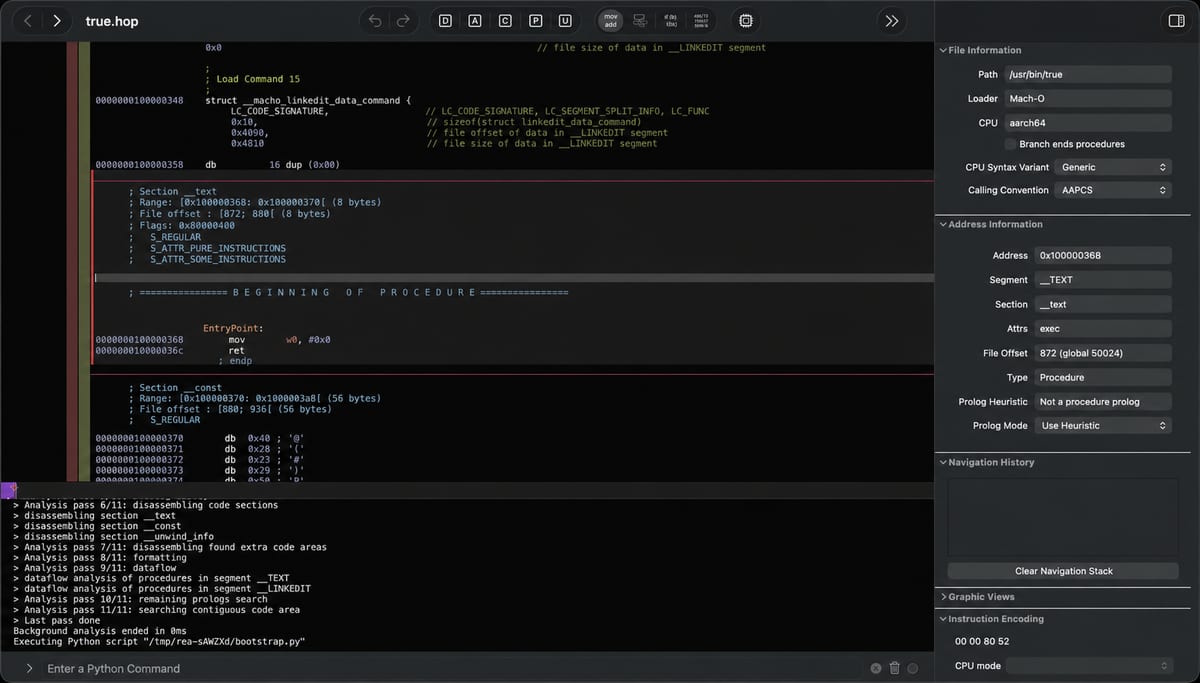
A hands-on review and demo of REA (rea-agents 6.4.0), showing installation, Ghidra setup on Apple Silicon, decompilation of a self-written stripped binary, and mapping an Electron app's IPC export flow.
YouTube video covering Reverse Engineer Anything (REA), a free open-source MCP that lets AI agents analyse apps, websites and device artifacts so they can rebuild a working version. The presenter shows Claude setup, a live demo reverse engineering the author's own funnel scheduling page into a custom calendar app, the supported targets (websites, Android, Flutter, devices, file formats) and REA's six-step reverse-engineering workflow.
A hands-on review of REA (morluto/rea, rea-agents on npm), an open-source MCP tool that lets AI coding agents reverse engineer apps. The author points REA and Claude Code at the shipped files of Bruno, an open-source MIT API client, and produces a behavioural report in 22 minutes for $0.81, then verifies the main claims against the source and a short live network capture. The video covers what REA is and is not, which servers the app contacts, why a telemetry opt-out may not stop everything, HTTPS certificate checking, a hidden feature, the report's limits, and three warnings (fake copies, no sandbox, legal).
A 5-minute video explaining what REA (Reverse Engineer Anything, rea-agents 6.4.0) is, how to set it up as an MCP server with Claude Code via Node.js, JDK and Ghidra, and what reverse engineering can and cannot do. The demo runs a blind test on Command & Conquer: Red Alert, checking REA's 8 claims against EA's GPL v3 source code; 7 of 8 were exactly right, with the single miss illustrating where human judgement is still needed.
One sponsored card rotates in after every 6 projects
Advertise hereA Threads post introducing the open-source REA (rea-agents) tool, showing the one-line install command `npx rea-agents setup`, noting that all analysis runs locally on the user's machine, and linking to the GitHub repository github.com/morluto/rea and its Korean documentation.
A short explainer on REA, an open-source MCP tool that plugs AI coding agents into reverse-engineering tooling such as Ghidra, Hopper and JavaScript analysis. It walks through two published examples—Notion's Electron clipboard bridge and a DX-Ball sound-pan function—and discusses why native binaries and JavaScript need different analysis approaches, what 3,205 behaviour cases were checked, and the limits of reconstructing a whole app. Practical advice: start with one feature, demand code evidence, list unknowns and compare behaviour.
A walkthrough of REA (Reverse Engineer Anything), an MIT-licensed MCP tool that lets AI coding agents analyse binaries through Ghidra, Hopper and IDA. The video demonstrates REA's JavaScript analysis on a game the author wrote, covers a third-party port that credits REA, and reviews limits, rights, access-control and privacy considerations.