


morluto@morluto
Reverse engineer anything with agents, from app behavior down to native binaries.
REA (Reverse Engineer Anything)
Stars 470.4K
Real cases of what people did with REA (Reverse Engineer Anything), the open-source MCP server for reverse engineering, each with its original source.
17 casesReverse engineer anything with agents, from app behavior down to native binaries.
One sponsored card rotates in after every 6 projects
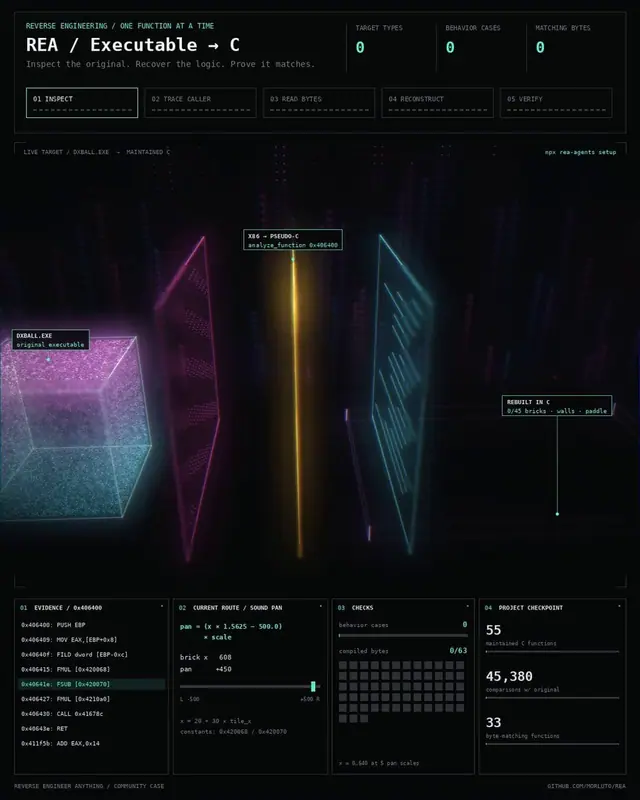
Advertise hereAn X post describing how AI agents used REA (the reverse engineering MCP) to recover functions from the DX-Ball executable, reconstructing a C version one function at a time with byte-for-byte comparison against the original x86 code.
 ▶ ♫
The author tests REA (Reverse Engineer Anything), the reverse-engineering MCP, using his own open-source application Elite Pen as a case study, restricting access to the source code in order to analyze the compiled binary and obtain pseudocode.
The developer shares a red-team style reverse engineering of their own closed-source p2p communication app using REA (morluto/rea), providing multi-platform binaries and documentation, and releasing a decompiled repository to examine how much can be recovered.
Impressions of using REA: Reverse Engineer Anything to analyze an old Windows app. After analysis, instructing it to analyze the UI makes it capture all features and even create an HTML screen list.
A post describing using REA with an AI model to explain how features of an app the user owns or is allowed to inspect are implemented, citing REA's showcase where a game function was recovered from a compiled binary and passed 3,205 tests.
 ▶ ♫
One sponsored card rotates in after every 6 projects
Advertise hereA Reddit resource map that introduces REA as the starting point for agent-assisted reverse engineering, with setup steps, worked investigations, and links to native, .NET, Electron, iOS, and MCP tooling.
An X post introducing REA (Reverse Engineer Anything), an MCP tool that lets AI agents analyse JavaScript/Electron apps and native binaries, with a quick-start guide (Node.js 22+, npm install --global rea-agents, rea analyze-javascript-application).
A short explainer on REA, an open-source MCP tool that plugs AI coding agents into reverse-engineering tooling such as Ghidra, Hopper and JavaScript analysis. It walks through two published examples—Notion's Electron clipboard bridge and a DX-Ball sound-pan function—and discusses why native binaries and JavaScript need different analysis approaches, what 3,205 behaviour cases were checked, and the limits of reconstructing a whole app. Practical advice: start with one feature, demand code evidence, list unknowns and compare behaviour.
An official REA plugin for the Hermes agent is announced: one install brings the REA MCP plus a reverse-engineer-anything Skill adapted for Hermes, exposing about 170 tools behind tool search for inspecting native binaries, .NET, Electron apps, Android packages, firmware, browser captures and live process activity. Requirements include Hermes 0.22.1 and Node, and the user supplies Ghidra, Hopper or IDA for native decompilation; the Skill asks for confirmation before anything that runs or changes a device.
A hands-on review and demo of REA (rea-agents 6.4.0), showing installation, Ghidra setup on Apple Silicon, decompilation of a self-written stripped binary, and mapping an Electron app's IPC export flow.
A developer compiled their own iOS app into an executable and gave it to AI. Without providing the source code, using REA with Ghidra, the profit/loss calculation formula was restored within 16 minutes. They shared the process from two failures to success after adjusting settings.